Hudson Valley’s Finest

Rossi Rosticcerria & Sons (Rossi’s Deli) has been my favorite lunch spot for home-style Italian cookings. The place runs by the family, and everyone is friendly. I have tried almost everything on the daily specials and have not been disappointed yet. Some of my returning dishes include beef shishkabob, roast beef with pasta, and spinach lasagna. Took my mom there once, and she approved. As a fine chef and a demanding food critic, her approval means the food has to be tasty and healthy.

Fine European Pastries

Located in Braintree, Massachusetts, Konditor Meister bakes some of the finest European-style cakes that suit my preferences: rich in flavor but light in sweet. From the delicate flour to the delightful filling to the delectable buttercream frosting to the delicious chocolate dipped strawberries, Strawberry Grand Marnier is a heaven-sent treat. If you’re in the Boston area and need a fantastic cake for your special occasion, “let Konditor Meister bake the cake of your dreams.”

Paris By Night 78: Duong Xua

One of Thuy Nga’s recurring programs is introducing Vietnamese songwriters. Paris By Night 78: Duong Xua featured songbooks of Quoc Dung, Chau Ky and Tung Giang whose works have been covered numerous times. Yet, Thuy Nga’s producers and arrangers have crafted new sounds and chosen right voices (most of the time) to give these dated songs new flavors.

Khanh Ha starts off the show with a fresh rendition of Quoc Dung’s “Chi La Mua Thu Roi.” If there were a fire, the dancers and Khanh Ha would be roasted in those weird outfits that were made out of magazines. Quoc Dung is a passable singer. His duet with Thanh Mai on the medley (“Que Huong va Mong Uoc,” “Bien Mong” and “Ben Nhau Ngay Vui”) brings us back to three decades ago when the two sang together in Sai Gon. Then Luu Bich and the musicians give “Hat Mua va Noi Nho” a new vibe by injecting bosa nova into Quoc Dung’s pop tune (mad props to the horns blowers). The most astonishing part of Quoc Dung’s portion is the combining of “Con Gio Thoang” and “Trai Tim Toi Loi.” Bang Kieu and Thanh Ha have done an outstanding vocal job, but what makes the performance indelible is Vuong Huong’s profound piano presentation. Her solo is unbelievable. Every finger she drops releases emotion (Don’t believe me? Check out her rendition of Trinh Cong Son’s “Bien Nho,” via Song Vinh). On the flip side, Manh Quynh could not express “Chuyen Ba Nguoi” to its fullest, and Ho Le Thu bares her skin instead of soul on “Chin Con So, Mot Linh Hon.”

Chau Ky’s part of the show is for the older generation. Che Linh gives a flawless recovering of “Tuy Ca,” a song that once made him popular. He maybe aged, but his voice is ageless (it must be the liquor that clears his throat). Phuong Hong Que and Mai Truc provide a savory medley on Chau Ky’s standards: “Khuya Nay Anh Di Roi,” “Em Khong Buon Nua Chi Oi,” “Giot Le Dai Trang” (the story behind this song is intriguing. Too bad, Nguyen Ngoc Ngan cuts him off) and “Dung Noi Xa Nhau.” Like Che Linh, Hoang Oanh’s vocal is yet to be matched on “Sau Chua Thay Hoi Am.” If Thuy Nga could invite Thanh Thuy for an encore on “Tieng Ca Do Ve Dau,” it would have made a deeper impact. Truong Vu does a fantastic job, but “TCDVD” is a Thanh Thuy’s signiture.

Tung Giang’s section shifts back to the younger audience. Duong Trieu Vu’s rhythmless two-step is less than convincing on “Biet Den Thuo Nao.” Nhu Quynh’s stilted flow screws up “Anh Da Quen Mua Thu.” Putting Nhu Quynh with Luu Bich and Khanh Ha, what were they thinking? It’s like country meets pop and jazz. Tran Thu Ha would have been a better choice. In fact, Khanh Ha, Tran Thu Ha and Thanh Ha would make a great trio. They can call themselves “Ha Ba Sac” (Three Ha’s Colors). Each brings a unique hue to the palette. Strongest from Tung Giang’s set is Tran Thu Ha’s pop-jazz “Toi Voi Troi Bo Vo.” Her version is both unique and creative. She has her chops down to the ground, and Thuy Nga is smart for allowing her to do her things. She brings a new group of audience that Thuy Nga never had. Thuy Tien then wraps up the show with the bouncy “Nguoi Tinh Nguoi Dep Xinh Xinh.” The song is perfect for her because she is a doll. She has always appeared to be cute with her baby face, but the make-up gives her a more matured look this time, which is very attractive.

Thuy Nga has toned down the sexy appearances for Paris By Night 78, and focused more on the musical productions. Now that’s what I am looking for. Does that mean Thuy Nga has read my previous review? I doubt it, but at least we are on the same page on this well-crafted video.

Commoner’s Cuisine in NYC

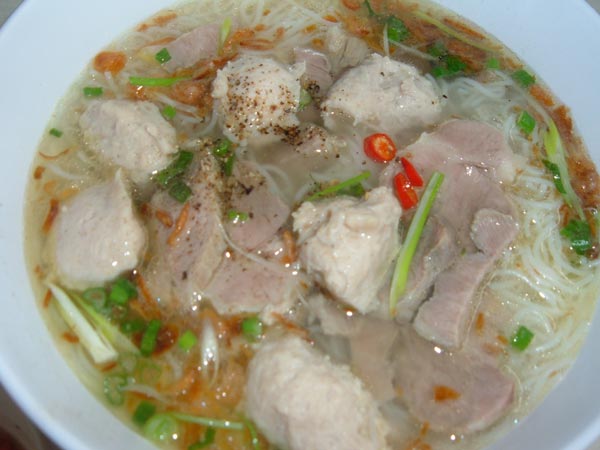
Thanh Huong, which located deep inside an alley on Canal Street of New York Chinatown, reminds me of com binh dan (commoner’s cuisine or food for workers) in Viet Nam. The place is extremely small and only wide enough for a few tables, but the food is amazing. Thanh Huong is a kind of place that doesn’t need to find its customers, but the customers will find it through words of mouth, and that is how I learned about it. My first dish was Bun Bo Hue (Hue’s Style Vermicelli Soup), which was highly recommended to me, and it was delicious. The broth was spicy and savory, just like the one I had in Hue couple years ago. It was so hot that I needed a glass of fresh-squeezed orange juice to cool down my system. I was sweating while slurping. After finishing up my bowl, I noticed a guy next to me ordered a gigantic plate of rice with Thit Kho (Pork Simmered in Caramel Sauce), Dua Gia (Pickled Bean Sprouts) and Tom Rim (Shrimp Simmered in Fish Sauce), which also made my mouth watery, but had to save it for next time.

Visualgui.com Meets Accessibility

Ladies and gentlemen, I am about to blow my own trumpet with Louis Armstrong’s style: clear and loud, so please cover your ears. While checking out an Apple store (in a mall, not online), I felt in love with the 30-inch Cinema Display. Of course, the first thing I wanted to do was to find out how Visualgui.com looks on such a huge screen, and I am impressed. Instead of getting large white space on the sides like Apple’s own website, Visualgui.com is filled the screen with the image background (like I said in my Visual Changes post, folks with large screens get extra bonus). Here is the normal-text-size screenshot, which has been resized from the width of 2550px to 800px. And here is the screenshot that had been zoomed out by increasing the text size. Notice how the site scales to fit the 30-inch Display. Users with low vision will surely appreciate the flexibility of the site. I am proud to present to the world a Web site where design meets universal usability. Visualgui.com also passed 508 standards according to Cynthia.

New Site Design

Susan Stein Shiva Theater is a small project that was passed on to me from Jacob Moses who is a student at Vassar; therefore, he deserves the credit for creating the logo. Since he did a great job, I just built a simple and straightforward layout based on his design. Although we don’t work directly with each other, it is still a collaborated effort.

More Details on Ngoc Lan’s Night

Ngoc Lan’s Night has been mentioned on TNT (Tieng Nuoc Toi) radio hosted by Thuy Tien. Thanks to my man Nam Loc for his support. Mad kudos to Thuy Trang aka AngelNgocLan (the organizer of Ngoc Lan’s Night) for making it happens. All her hard work, from contacting the special guests (Nam Loc, Thanh Lan and Truong Ky) to getting the band together to creating posters and tickets, is surely appreciated it.

I forget to include in my last post that your donation (cover charge that includes a 9-course dinner) will go toward the National Multiple Schlerosis organization. So please come out and support the event.

Update: Just booked my ticket. See you all there.

Zoomable Layout

Visualgui.com has been recoded to bring accessibility up another level. Now users can adjust the text size and the layout will scale accordingly. I also switched from three-column to two-column layout to allow the content area to be wider.

Sarah Horton – Access by Design

Why universal usability is as essential as the visual layout on the Web? Why keeping the site clean and simple is important? Why should we replace graphic with text navigation when possible? How to create forms that are painless to fill out by both visual and nonvisual users? Web designers who are unsure what the answers are to any of these questions should take a look at Sarah Horton’s Access by Design: a Guide to Universal Usability for Web Designers.

By eliminating the technical practices, Horton allows her book to focus on the design principles; therefore, anyone (with or without technical skills) who wishes to learn Web accessibility is welcome. With simple language complemented by clear visual illustrations, she walks readers through everything they need to know (including text, images, color, forms, links, lists, audio, and video) when creating universal usability for the Web. She points out what to do and what to avoid when designing for maximum accessibility, and shows both good and bad examples to back up her cases. For instance, nonvisual users may have a hard time distinguishing between parent and child items in compound lists; therefore, she suggests to either use ordered lists or break the compound list into sections with appropriate headings.

Although Horton favors flexible over fixed layouts, she does a thorough job of explaining the pros and cons of both designs. While the fixed design does not expand when users increase the text size, the flexible design causes readability issue with long lines of text. From my own experience, using em measurements is the best solution to accommodate readability. The default is presented in a fixed layout, but the text and the layout will expand or condense when users adjust the text size, and that is “where designers and users share control of its design.”

Access by Design offers nothing new on Web accessibility, but Horton’s clear and concise approach makes the book an important reading for Web designers and developers, especially the newcomers. Read it, learn it, and keep it by our side when working on Web sites.

Luu Hong – Mua Dem Ngoai O

Luu Hong is one of the most overlooked musicians in the Vietnamese-American community. If she didn’t collaborate with Ngoc Lan, I would have not known her. The medley (“Lien Khuc Chieu Mua”) that they worked together for Asia Entertainment was breathtaking. The way their voices complemented each other on Trinh Cong Son’s ”Nhu Canh Vac Bay” and Nhat Ngan’s ”Qua Con Me” was like a smooth blend of an alto sax (Ngoc Lan) and tenor sax (Luu Hong) floated over Asia’s crisp arrangements with endless imagination. I was blown away by their performances.

Obviously, Ngoc Lan was no stranger to me, but Luu Hong was. Her distinctive voice mesmerized me. She had just the right amount of thickness in her vocals that would give any song that she sings some textures. Her phrasings were effortless, and her timings were perfect even though Asia’s beats were faster than the original tempos. Her rendition of “Nhung Doi Hoa Sim” (poem by Huu Loan and music by Chinh Dzung) on the medley was one of the best I have heard.

After listening to “Lien Khuc Chieu Mua”, I determined to get Luu Hong’s solo albums, but could only found one from Ca Dao Productions. Even though I was disappointed by the horrible cover design and the lack of credits (songwriters and producers), I copped Mua Dem Ngoai O anyway because I know the voice is incomparable. I was hoping for the production to be at least decent for her to ride on.

The good part is that the arrangements are sharp. The not-so-good part is that I have heard of them countless times before. I am not even sure how old the album is, but it does not matter because the old tunes bring back good old memories. While the tango joints like “Ai Di Ngoai Suong Gio,” “Ngang Trai” and “Do Chieu” take me back to ballroom floor, the waltz groove on “Tinh Mua Gio” makes me want to whirl around the room like Nguyen Hung and Thuy Van on Da Vu Quoc Te.

Luu Hong’s song selections are romantic ballads (nhac tru tinh). Nothing’s wrong with that. One of her strengths is her ability to maintain her effortlessness when approaching songs like “Diep Khuc Thuong Dau,” “Dang Do” and “Tuyet Tinh.” Her heartfelt emotion is there on the tracks, but her expression is never mournful. A few singers have sing these songs like their worlds have come to an end, and I can’t get with that. On the title track, “Mua Dem Ngoai O,” her slightly gruff timbre hugs around the soothing saxophone giving a vivid image of a rainy night in a quiet countryside somewhere in the west of Viet Nam.

Dem Mua Ngoai O is a delicious set from song to song that could be replayed for savory experiences. I don’t know if Luu Hong is still singing or not. Her voice is hypnotizing, and it would be a darn shame if she has retired.